
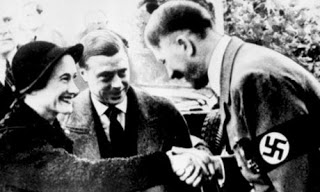
Hitler-460x276Rejoice, radicals! The Royal Episiotomy has been performed with averted eyes, the Royal Meconium is working its way through the a line of bowels that dates back to William the Conqueror / William Of Orange / King David!

And radicals should rejoice, for, as this blog post shows, monarchy is one of the things that saves us from fascism!

Except, of course, it isn’t. In fact, I’m going to argue that having a monarchy (or having a large landed aristocracy, of which a monarchy is a normal part) makes a country much MORE prone to fascism. Right. Here we go.

First, it’s pretty clear David Boyle is stretching any evidence he can find to fit his thesis. His argument is that when monarchies go, ‘very rapidly’ fascist dictatorships arrive, as they did in the last century in Germany, France, and Spain.

We’ll give him Germany, for the sake of generosity.

I’m not sure what he means by suggesting that France became a fascist dictatorship, because it quite famously got rid of its monarch in 1789. More than a century before fascism existed. If he’s referring to Petain’s regime, it’s a bit odd to suggest that fascists ‘very rapidly’ replace monarchies when there’s a 150-year gap between the two.  In fact, one might suggest that being invaded by fascists is a much quicker way of making a country fascist than losing a monarchy seems to be.

In the case of Spain, the fall of the monarchy led to the rise, of course, of an anti-Fascist government. It was, among others, monarchists who helped overthrow the elected government and install a fascist dictator. It’s worth remembering that Franco ruled as Regent To The King Of Spain. Far from being a bulwark against fascism, monarchy was the only justification for it. Franco didn’t need to have elections because Franco was ruling in the king’s stead.

And let’s not forget Italy. If only Italy had had some sort of monarchy to stop the fascists coming to power. Some sort of monarch like Victor Emmanuel III. Whom they did have.

Or Albania! Let’s not forget how having a monarchy stopped (didn’t stop) their country falling into the hands of fascists.

Still, they’re all foreign countries. What about Britain?

We probably shouldn’t constantly need reminding of the royal family’s flirtations with Nazism, nor the fascination it held for a significant part of Britain’s aristocracy.

(For the next bit, I’ll put some footnotes in. Footnotes = fun!)

THINGS TO REMEMBER:

1) During the 1930s the Queen Mother used to give Cabinet members copies of Mein Kampf, describing its “obvious sincerity” in the inscription she wrote for the Foreign Secretary Lord Halifax. When she was reading it, she described it to her mother as “very soap-box, but very interesting”. (1)

2) Her husband, George VI thought he could probably sort out the whole war nonsense if he just wrote a personal letter to Hitler. After Chamberlain signed the Munich Agreement appeasing Hitler in 1938, both the King and Queen brought him out onto the balcony of Buckingham palace to thank him, something which is of debatable constitutionality. (2)

3) The Duke of Windsor, as Edward VIII became after he abdicated, gave interviews during the Second World War that were so defeatist that Winston Churchill threatened to court martial him. In 1940, he said:

In the past 10 years Germany has totally reorganised the order of its society … Countries which were unwilling to accept such a reorganisation of society and its concomitant sacrifices should direct their policies accordingly.

In fact, listing the incidents in which the Duke of Windsor expressed sympathy with the Nazis, or hatred for ‘natives’ or ‘Central European Jews’ would take too long. Let’s just say that he asked the Nazis to look after his holiday homes, which they did, he was probably going to be reinstated as king if Hitler won (which sort of undermines Boyle’s whole thesis), and up until the 1960s he held that the Second World War was caused by “Roosevelt and the Jews”. (3)

philipfuneralL060306_450x3104) Not that he was the only royal to think like this. Prince Philip (who, let’s not forget, had brothers in law in the SS and SA) explains the thinking of the time: “I can understand people latching on to something or somebody who appeared to be appealing to their patriotism and trying to get things going. You can understand how attractive it was.” In the same interview he goes on to say that there were, within his family, “inhibitions about the Jews” because people were “jealous of their success.”

Let that sink in, for a few minutes. That’s a prince by dint of birth, whose sisters married Princes of Hesse, and who married the heir to the throne of the United Kingdom being jealous of other people’s success.

Put in that context his constant ‘politically incorrect slips’ or ‘actual racist comments’ don’t seem quite so harmless (as if an unelected consort to a head of state, one of the richest and most powerful men in the world could ever be harmless while mocking the people he meets). His desire to come back as a virus and ‘do something about the overpopulation problem’ seems less eccentric. And his grandson dressing up as a Nazi becomes less of a joke. (4)

These are what Boyle calls “forces for inclusion and tolerance”.

In terms of the wider aristocracy, however, the royals aren’t uniquely fascist. In fact, even when they’re leaking information to Ribbentrop (Duchess of Windsor) they’re barely fascist compared to lots of the aristocracy. Let’s not forget that, as late as the 1970s, Lord Lucan, Lord Aspinall and James Goldsmith were ‘imagining’ a coup and someone was funding Peter Wright and other MI5 agents to imagine it in slightly more concrete terms. (5)

In 1972 Lucan bought Mein Kampf and a biography of Turkish dictator Kemal Ataturk in one trip to Hatchards, and the Countess of Lucan said: “He did have very right-wing views, some might describe them as fascist. I didn’t know he was indulging in extremist reading matter in 1972, although I knew he listened to recordings of Hitler’s speeches at Nuremburg Rallies.”

Just a general tip, if you don’t know if your spouse is getting heavily into extremist reading matter, if he listens to the Nuremburg Rallies for fun, THAT’S A CLUE!

The playful flirtation of the British right wing – and particularly its aristocratic arm – with fascism, from Alan Clarke’s fairly naked espousal of pro-fascist views to Neil Hamilton’s speaking to neo-fascist student groups in Italy in the 1960s and giving Nazi salutes at the Reichstag (6) is always striking.

Far from being a bulwark against fascism, a monarchy, the monarchy, our monarchy, has been its biggest asset.

1) Counting One’s Blessings: The Selected Letters of Queen Elizabeth the Queen Mother, William Shawcross (2012)

2) Munich, 1938, David Faber (2009)

3) A lot of this is from The Duke Of Windsor’s War, Michael Bloch (1982) “Roosevelt and the Jews” is from Sebba, Anne, “Wallis Simpson, ‘that Woman’, After The Abdication”, New York Times (2011)

4) Most here is from Levy, Andrew, “Prince Philip Pictured At Nazi Funeral”, The Daily Mail (2006)

5) Martin Bright, “Desperate Lucan Dreamt Of Fascist Coup”, The Guardian (2005)

6) Sweeney, John, Purple Homicide (1997)
Dear Electricity & Gas Providers,

I’m writing to you because I’ve been given your name by a mutual friend / saw your stuff and really loved it. I’m currently looking for someone to heat and light my house, and was wondering if you’d be interested in doing it?

Unfortunately, there is no pay at this time, but it’s a great opportunity to get in on the ground floor as in the future I hope to be heating and lighting ever-bigger houses. It’s also a great chance to showcase your work to the sorts of demi-celebrities I spend much of my life with. 

You’d be boiling the tea for Darren Strange who was in Parents on Sky1. You’d be powering the phone calls I make to all sorts of household name comedians, all of whom would be exposed to your work that way. You’d be powering tweets that are occasionally retweeted by Josie Long and Mark Thomas!

While I understand the remuneration might not be quite what you’re hoping for, I hope you’ll be excited by the opportunity to be a part of the incredible project that is my household. It’s going to be huge!

I can also offer you drinks if you’re ever in town, and tickets to an exclusive viewing of the work you do in our house next time you come to check the meter.

I know you’ll be as excited by this as I am!

Thanks,

Nathaniel Tapley

Sir Ian cannot stand by and let his friends be maligned any longer…

Sir Ian’s latest thoughts…

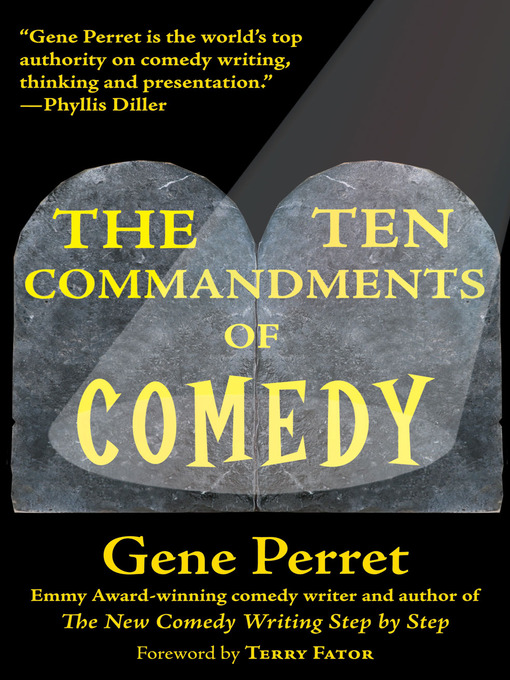
{3F906611-666D-4714-A16B-3BF445DCD7B3}Img100Gene Perret’s other book – The New Comedy Writing Step By Step – is a thorough introduction to gag writing. It covers all of the basics, and includes many exercises on which neophyte comedy writers can try out what they have learned. Whilst some of the material may have dated, and it’s focused very much on gag writing rather than performance or sitcom writing, it’s one of the standard texts for people looking to learn how to write jokes, and deservedly so.

The new one – The Ten Commandments Of Comedy – is… different.

A slim volume, The Ten Commandments gives 10 principles for the writing of jokes, and show’s how you can punch a joke up by seeing which of them it violates. All of the rules are good, make sense, and are things every comic should know.

And that – I think – is where the problem is. Any working comic or comedy writer will know these rules, even if they have never thought of them explicitly. They will know from experience the value of being concise, of being understood, of giving the audience definite beats on which to laugh.

Let’s be clear – all of these points are valuable, well worth knowing, and important to bear in mind when writing comedy. However, they aren’t examined in any depth. There’s a little more context than the original Ten Commandments had, but not by much.

The chapters are short, so it’s an easy read, but it also makes it a not-exceedingly-useful one.

it’s difficult to know who would benefit from the information in this book, although all of it is worth having. In terms of what it’s saying and who needs to hear it, beginners would probably benefit most from it, but the absence of exercises or context mean that it’s not particularly helpful as a book to kickstart your  comedy writing.

Anyone for whom such a brief book might be useful will probably already know everything that’s in it.

There are 64 pages, each has helpful, well-argued information on. If I’m going to have to imagine who would benefit from this book, I would think that public speakers looking to inject humour into their speeches would do best.

For business people. after-dinner speakers, lecturers, and anyone who has to speak in public but doesn’t want to have to do a whole comedy course to find out the secrets, The Ten Commandments Of Comedy is a helpful primer, with real insight into what makes people laugh. In a few brief chapters you can be apprised of all of the fundamental principles of jokes, and reminded of what you really shold know when you write and tell them.

For comedy writers, however, I can’t imagine a stage in your career when this book wouldn’t either be redundant or too sparse to be helpful.

The Ten Commandment Of Comedy, then, will be most useful for those who don’t do comedy. For the rest of us, start with his other book.

[FULL DISCLOSURE: This review was based on a review copy sent to me by the publisher.]

I straightened my Union Jack tie and looked straight down the lens. Was I really going to do this? Today? Well, there was only one way to find out…

Did you hear the one about the Woolwich murder? Probably not, comedy’s been a little quiet on the subject for the last week. Even Twitter, where paedophilia, death, and genocide can provide punchlines mere moments after they’ve happened* seemed muted.

Usually, a tragedy is the time at which Twitter divides (roughly equally in my timeline) between those making puns about it, and those saying “Hey! A man / woman / Thatcher just died here people! Show a little respect!” Last week, half of those people suddenly seemed to discover that discretion was the something part of whatsit, and decided to stay quiet.

When a Dutch show included a cheap reference to the murder in a sketch about Eurovision, the hyperventilation of the British press (who, lest we forget, are staunch defenders of freedom of speech) became a constant, high-pitched whine capable of shattering snail shells. All of the coverage mis-characterised the sketch as ‘mocking the murder of Lee Rigby’. All of the headlines named Lee Rigby, who wasn’t referred to in the sketch at all, as the butt of the sketch. It’s pretty clear from watching it that they weren’t mocking Rigby at all, they were using his murderers as a stereotype for all of Britain, the same way they were using German stereotypes for the Germans.

But any joke which contains reference to the Woolwich murder is – in the eyes of the British press – a joke that mocks Lee Rigby.

In character as Sir Ian Bowler, a corrupt MP, on the Thursday morning I tweeted a not-hugely-amusing joke about MPs resenting being recalled to Parliament every time they went away on holiday. I was surprised by the fact that someone was hurt by it. I’d actually made someone cry with a joke. And not in a speaking-truth-to-power way, in a you’re-probably-an-inconsiderate-dick way.

So I decided to ask social media whether or not I should do an Ian Bowler video that day. There was a lot I wanted to say about the responses of politicians to the incident, and the ways in which they were spinning it to suit their own agenda. I was cross that the half-truths (which are equally half-untruths) of a whole swathe of people from Theresa May to the EDL weren’t being challenged in the media’s narrative. I was angry. And when I’m angry I tend to put on a blue suit and bellow into a camera.

Like during the riots.

But I’d been brought down to earth by that tweet. Should I say something that I knew would upset a lot of people? Should I say it that day?

The responses were interesting. The advice from most comedians was to leave it well alone. Most people who like watching the videos wanted one. Family members (mine) politely suggested that holding off might not be a bad idea, at least until they had had time to board up the windows.

One comment, however, completely took the wind out of my sails.

 I think Sir Ian should be thinking about the victim’s family, not his own career.

I’ll deal with the issue of respect in a minute, but the accusation of careerism was particularly painful. I don’t know what sort of career the commenter assumes talking into a video camera in a shed comprises (My wife could tell him. “Not much of one.”) but it was a point I couldn’t answer.

As someone whose career is his jokes, and often his jokes in response to the news, I can’t help but be something of a vulture, picking at the carrion of current affairs. It’s what I do, it’s the way I communicate. Some people write columns in newspapers, some people write plays, some people go and nod at each other on news programmes. I write jokes. They are the way I work out what I’m thinking.

When it comes to respect, of course, I don’t think it’s the satirist’s job to offer respect. Quite the reverse, when the whole country is united in feeling something, it’s the satirist’s job to point out the ways in which we are blinding ourselves to the truth. Or to what they see as the truth.

Even if it’s wrong, especially if it’s uncomfortable, there should be someone taking an unpopular position.

Someone should always challenge the prevailing media narrative, especially when a consensus is reached as quickly and completely as it was last week.

If a satirist has a duty it is not to show respect, not to defer to the social norms which are being used to silence and ensure conformity of word and thought.

There was a survey recently, which scientifically proved (did not scientifically prove) that there was such a thing as ‘too soon‘. Distance in time allows us to see the violation of social norms as ‘benign’. However, in a country where we are all more than happy to work ourselves into a group-think lather at the drop of a people’s princess, one must wonder whether our humour should be ‘benign’.

Gawker recently lamented the fact that ‘too soon’ had apparently disappeared from the world with social media. The response to the Boston bombing showed, they thought, that Twitter had killed the concept of ‘too soon’. What they might have seen in the Woolwich case is the way in which Twitter is used to police ‘too soon’.

There have, of course, been jokes. Sickipedia has 5 pages of jokes about the Woolwich murder. Most of them gleefully taking the opportunity to be openly racist.

The left has also found its outlet: the EDL. From the EDF gags to the ‘Never Submit to Aslan’ photoshops, the EDL are the one thing the country is letting itself laugh at. The anarchist blogger who pleads with his audience not to laugh at the EDL may well be right that the problem they pose is serious and imminent. However, in a culture where the central tenets of the narrative are not open for mockery, we latch onto the next closest thing. Sorry, EDL.

In their responses to the Aurora shootings both Dane Cook and Chris Rock had different experiences. Cook used the tragedy to make a tired joke about how bad the film was; Rock used it to raise issues of gun control and joke about them.

One used the moment to joke about the issues, his anger, and what he felt was important, and was rightly praised for so doing. The other used it to trot out some hack material, and caught the rage of the Internet.

There is no such thing as too soon. There is, however, such a thing as too stupid.

I’m a great believer in the fact that not all self-censorship is wrong. Taking the impact of what we say into account when we say something is not a betrayal of free speech. Taking responsibility for our words and the effect they have on others isn’t always a bad idea.

However, we shouldn’t frame all of our discussions as if they are likely to be beamed directly into the faces of grieving relatives, even though, with the Internet, they can. And we really shouldn’t let concerns about what people will think our motives are govern whether or not we speak out.

Ian Bowler will be back tomorrow. Some of the things I wanted to say still need saying. Other seem tired now, or trite, or just like I couldn’t pull them off as my rage has matured. Look forward to that. Some slightly stale material that feels like it would have been more relevant last week.

Because I didn’t do it. I switched the camera off, took off the tie, turned on the News, and felt awful. Awful that I was conspiring in silence, awful that I hadn’t had the courage of my convictions, awful that I hadn’t said something deeply offensive to right-thinking individuals. Just awful.

* For those unaware of Twitter, it’s a system used to ensure that Frankie Boyle gets pretty much blanket coverage by The Daily Mail.

Ed Milliband MP speaking at the Labour Party c...

Ed Milliband MP speaking at the Labour Party conference. (Photo credit: Wikipedia)

This morning, Ed Miliband gave a speech at Google’s Big Tent event. Here’s a transcript of part of it.

I’d like to start by showing you four pictures and asking you to decide which is the odd one out, because it’s reveals the theme of my talk: what kind of future we want to build.

The first is my dad. His name was Ralph Miliband. He was a Marxist Professor.

The second is Willy Wonka, the genius who owns the factory in Charlie and the Chocolate Factory and eventually gives it all away to Charlie’s family.

The third is Margaret Hodge, Labour chair of the Public Accounts Committee, who, as you know, has been very critical of Google in the last few days.

And the fourth is Google, along with your founding slogan: “Don’t be evil”.

So, as they say on “Have I Got News from You?”, I’d like people to tell me who is the odd one out.

Well, I’ll tell you my answer.

My answer is that it is my dad.

Because he’s the only one who thought that the route to a fair society was not through capitalism but through socialism based on public ownership.

It wasn’t just my dad who thought it, of course.

Until 1995 this view was enshrined on the membership card of the party I now lead.

Tony Blair got rid of it and rightly so, because nationalising the major industries is not the route to a fair society.

That’s right. It’s the Labour Party’s position now that fictional chocolate factory-owner offers a better model for society than Clause 4. So, let’s look at exactly what kind of model for capitalism, Mr Wonka provides.

WORKFORCE: Taking advantage of a large population of displaced peoples with limited language skills (Wonka boasts that this makes them immune to attempts at industrial sabotage), Wonka has no native workers in his factory at all. By employing physically-handicapped immigrants, who appear to be in a situation close to indentured servitude he further depresses wages in Britain and exploits a community he seems unwilling to help repatriate.

HEALTH AND SAFETY: Wonka has a woeful safety record. On a recent visit of 5 children to his factory, 4 ended up dead or severely shrunk from their short time in the factory. As an additional point, the correct way to move a girl who has been turned into a giant bluberry is not to roll her, but to lift from the knees.

COMMUNITY: Far from being a responsible employer, whose outreach ensures that the whole community benefits from the presence of a factory, Wonka shuts himself away, letting no one into or out of the factory. Indeed, he occupies a prime slice of local real estate that could be better used for social projects, as there seems to be no rational reason why he maintains this location in the city centre.

ENVIRONMENT: We can only assume that the chocolate river has been formed by the melting of the chocolate ice-caps, and his factory’s continual belching of purple smoke suggests that Wonka’s environmental record may be less than stellar.

ANTI-COMPETITIVE: The Everlasting Gobstopper is clearly a way to lock people into one gobstopper format for the rest of their lives, and to reduce the market share for all other competitors. Much like Amazon, it is using loss leaders to get people to use Wonka products, force competitors out of the market, before – presumably – raising prices when they are the only player left.

That’s the model Ed Miliband thinks we should be following in the 21st century. Anti-competitive, highly secretive, exploitative of both resources and people, giving nothing to the community.

Just as long as we know where he stands.

I’m a disaster at keeping this blog up to date. Partly, of course, because I don’t know what it is. Some days, it’s a place for blistering think-pieces on political hot-topics. Other days, it’s a receptacle for Bowler videos. And on other, shameful days, it’s a self-promotional wankbag.

This is one of those days.

If you didn’t come to The Bowler Debates last week (and you may have missed them because I never mentioned them on my own blog for fear of seeming too pushy), then all is not lost. A reviewer came, and made notes, and wrote those notes up afterwards into this lovely review. Thank you, Kat Pope.

The structure of this new show is simple but works perfectly… While it’s difficult to tell how much of the show is scripted and how much off the cuff, it doesn’t really matter as this is genuinely funny stuff… Tapley is always nicely in control of his character and material, but can’t quite hide a smile when he knows he’s nailed it, which is a good 80% of the time – not a bad comedy hit rate at all…  It’s a shocker, but then you’ll just have to go to see this marvellous hour of comedy to find out exactly what did happen between the two old chums.

Yeah. 80%. Boom!

Also, on Sunday The Revolution Will Be Televised – on which I wrote – won a BAFTA. No, I have no idea whether or not this means I can call myself a “BAFTA-winning writer” but, until I am absolutely and explicitly told not to, I intend to heavily imply it in all conversations.

So, that was my week. How was yours?


Sir Ian Bowler has been feeling conflicted this week…

[YouTube=” https://www.youtube.com/watch?v=3U1MB0TUiDs&feature=youtube_gdata_player”%5D