
You are currently browsing the category archive for the ‘self-promotion’ category.
(Warning: Many of these videos contain adult language and situations, varying picture quality, and frequent uses of ‘the c-word’. Usually in reference to Nick Clegg.)
The Coalition may be a disaster for old people, young people, poor people, disabled people, students, aircraft carriers, unemployed people, people who buy things, people with children, ill people, people who like sports, people who hate sports, and women. But for some of us things have never been better. Those of us in the musical comedy or protest singing games are experiencing a boom time. Us and the people who make riot shields.
Ever since the election there has been a profusion of online video activity: songs, raps, and poems all pouring out at an incredible rate. This is partially due to the availability of smartphones, and the fact that people can watch videos almost anywhere, at almost any time. It’s also, however, because of a palpable sense of anger, directed particularly at the Lib Dems, and, even more particularly, at Nick Clegg. Which serves him right for making this video: Liberal Democrats – Say Goodbye To Broken Promises
The videos range from the furious to the funny, from the wry and disappointed to the barely coherent rant. Perhaps the most obscene of them all is actually in danger of charting this weekend. Yes, on Sunday afternoon we’re in danger tuning into the chart countdown only to hear Kunt And The Gang’s “Use My Arsehole As C*nt (The Nick Clegg Story). More on that at the end.
I’ve trawled through the cuts-related songs, and have come up with a Top Ten. Sort of. There are ten of them anyway. So get your rioting shoes on, and boogie on down to the following inappropriate sounds…
10) Dan Bull – Another Prick In Whitehall
Even-tempered monotone rapper Dan Bull hoists Nick Clegg by his own petard, in a wonderfully bleak reworking of Pink Floyd’s ‘The Wall’. A delight.
9) Mitch Benn – I’m Proud Of The BBC
One of the earlier examples of the form, and although specifically relating to the BBC, this set much of the template for a lot of the songs that were to follow. The rest of the template is of people trying to rhyme the word ‘Clegg’ with the word ‘cock’. Sometimes with a surprising amount of success.
8 Sir Ian Bowler – Dear Students
This is one of mine. Some people like it. I am saying no more about it.
7) SUARTS – Can’t Cut This
Some impressive dancing in this MC Hammer parody from the students at SU Arts. But when, oh when, will someone tackle Sir Mixalot’s “I Like Big Cuts (And I Cannot Lie)”
6) Grace Petrie – Emily Davison Blues
This one’s not a comedy song, but a heartfelt protest song in the great British tradition. If they achieve nothing else, the Coalition can retire to their country estates knowing that they’ve led to a revival in earnest songs written in the first person plural that overuse the words “this land”. Beautiful and angry.
5) Dan Bull – Millbank Wankers
Lyrical reasonablist Dan Bull has another go this time in the sole example of the pro-police protest song on this list. Or, I should imagine, any other list…
4) Lee Kern – MERRY CHRISTMAS (X-FACTOR’S OVER)
Lee Kern gives a blast of pure, visceral fury here. It’s not actually to do with the cuts at all, it’s about X-Factor, but I was getting really tired of listening to songs about Nick Clegg (I get it. He’s rubbish).
3) Captain SKA – Liar Liar
Old-school reggae. About Nick Clegg. We’re living in a world turned upside down.
2) Samuel Gaus & Unnamed Accomplice – Universities’ Lament
Samuel and his unnamed friend here come up with some entertaining harmonies, but shouldn’t they be in lessons? If they’ve got time to write songs, they’ve got time to work in a call centre to fund their degree…
1) Kunt And The Gang – Use My Arsehole As A C*nt (The Nick Clegg Story)
This is a glorious masterpiece of obscenity. A dazzling example of filth, and it’s currently at Number 78 in the charts. If they can sell 3,000 more copies by Sunday (iTunes link) then we all get to eat our Christmas dinner knowing that a song with title is currently nestled in our nation’s Top 40. And they’ll have to play it on the radio…
So that’s it. A breathtaking rundown of the exuberant creativity that’s been provoked by the Comprehensive Spending Review. Again, not a sentence you often hear. Right. I’m off to rhyme Cameron with something…

Roar!
This is Gary. He’s a lion. And he’s useless. He’s Gary, the Useless Lion.
Yesterday, Gary made his first appearance in the wide world, and people seemed to like him. So you may be seeing more of Gary in the future.
To catch Gary in his natural habitat, make sure you watch Dick & Dom’s Funny Business next month. Or just pay attention to the Useless Lion listings in your local newspaper…
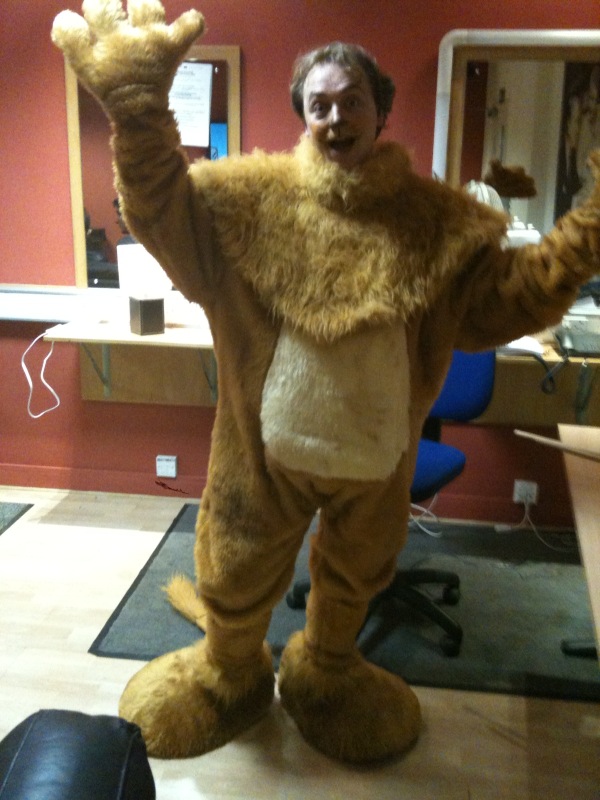
I was BORN to play this role...
In September the In The Gloaming podcasts won the Parsec Award for Best New Podcaster. We jumped around like victorious loons for a few seconds, until we remembered that we hadn’t made a new episode since March. And that we had no upcoming episodes in the pipelines.
To the outside observer In The Gloaming looked cold and dead, and only we knew there was still a flicker of humanity inside just waiting for the right time to blossom. It felt like being Nick Clegg.
There were lots of reasons that we hadn’t been able to do as many episodes as we’d hoped. People’s schedules clashed, they got work or didn’t get work at the wrong times, we weren’t getting as many downloads as we might have hoped (the episodes had been listened to about 6,500 times at that point). However, most of the reasons we weren’t able to churn them out on a monthly basis were self-inflicted, and could have been avoided with a little thought early on in the process.
So, here are my tips about what NOT to do, if you want to make an audio drama podcast of your own:
Don’t bother making audio trailers – One of the first groups of people to be interested in what we were doing was one comprised of people who were doing the same sort of thing. People like 19 Nocturne Boulevard or Wormwood. And they often wanted to swap audio trailers, little snippets that could be stuck on the end of another show to spread the word. We never bothered to make these because we were too busy making the shows themselves, and thought they probably wouldn’t be worth the time in the number of new listeners they brought to us. We were wrong. There is a very small group of people used to listening to new audio dramas as podcasts. Get them involved from the beginning. Be generous with your time and effort with other podcast producers. Trying to forge the path completely on your own is hard and lonely. These are people who would like to advertise your podcast for free. Let them.
Be half an hour long – This was, in some ways, an intentional error. Part of the point of In The Gloaming was to prove that we could make half hour shows of radio quality. We wanted people’s response to be ‘This should be on the radio’, and to prove that it was ready to be. However, people often split up their listening to a podcast, catching a few minutes on their way into work, so broken shows work well. Narrative comedies that require unbroken attention (including any magnificent aural soundscapes you may create) ask a lot of the listener, and finding half an hour to listen to an episode (forgoing half an hour of television or proper radio or actual interaction with other humans) can be difficult. It suited our purposes, but it was far from ideal for in Internet show. If you’re planning on doing audio dramas or narrative comedies, why not think about ten- or fifteen-minute episodes? They will be easier for people to find the time to listen to.
Don’t have a business plan – This isn’t quite true. We had a plan, it just wasn’t a hugely good one. It was (as I outlined above) Get Picked Up By The BBC. When that didn’t materialise the next obvious option was to look for a sponsor. However, those things we’d designed to make it more like a radio show made it less effective on The Internet, and so we didn’t have the subscriber numbers we needed to get a sponsor. We had a little income from the tip jar – enough to cover the podcast hosting – and we had a merchandising site, but nothing people wanted to buy on it. There were successful revenue streams: live shows, signed scripts, etc. However, by the time we had worked out how to fund the shows, we had stalled on producing them for long enough that the momentum was gone. The lesson here is: at least have an idea how you’re going to make enough money to cover your costs, and always implement your business plan quickly. You may well have a number of people willing to support you financially, so give them a way in which they can. Speaking of which:
Fail to make the things people want to buy – In our case: CDs. We’ve had lots of requests for CDs. People want to give them as gifts, people who aren’t au fait with downloading, people who want to show their support. There has been constant demand for CDs of the episodes. I did try to get this set up at one point, using Lulu, but found that they made all their CDs in the US, and then shipped them to England making them hugely expensive (even though we were only charging $4.00 each for them). I then wanted to add some audio liner notes to each one, a little extra that wasn’t available on the website, but never got around to recording them. The fact that there was no UK service that would do what we wanted and that I couldn’t be bothered to fulfil orders myself meant that we missed out on the one revenue stream that seemed promising.
Underestimate the amount of time it will take – Each In The Gloaming took a few days to write, a day to record, and two or three days to edit. That’s at least a full work week out of every month. When you’ve got children (or, you know, a job) that’s just not feasible. Perhaps we’ll do them quarterly in future, but monthly doesn’t seem like we can do it at all.
Post irregularly – We started with a monthly schedule, but soon got bogged down with diary incompatibilities, and just the sheer amount of work it was. The fact that we couldn’t be relied upon to produce podcasts every month meant that a lot of the momentum we started with dissipated. Set yourself a schedule and stick to it. Don’t stick to two-thirds of it. Stick to it, no matter how difficult it is. Then sit back, learn lessons, and plan Season 2.
Don’t collect emails – We never had an email list or any promotion beyond writing a blog. This is silly. Do better than us.
Don’t allow embedding – It took us six months to find a service that allowed easy embedding and sharing of mp3s on Twitter and Facebook. We went for a paid service that was not as good as what we could have got from WordPress, and didn’t offer the stats or functionality. We’re now faced with the rubbish options of continuing to use a (paid) service that isn’t as good as other ones or to change the website RSS feed, and risk losing all of the subscribers who are attached to the old feed. Do your research about how you’re going to distribute your podcast before you set up a standing order…
Basic, fundamental errors. Tonnes of them. We couldn’t have been more dim if we’d just dribbled into the Internet whilst smashing ourselves in the face with a flat-iron.
However, we’ve had more than 100 downloads a week, every week, for more than a year. We were asked to perform at the World Horror Convention 2010. It’s led to other bits of work, and to the selling of some of the short stories written for the site. The live show is getting a full run in the Brighton Festival next year (Friday 13th May, for those who want to book tickets). We’ve won awards. And we’ve got a producer attached, who’s making an In The Gloaming feature film, which should be out next year.
That’s how not to do it. Go and do better…
This article was first published on the The Spectator Arts Blog, on 14th October.
A couple of Thursdays ago, The Daily Mail told us, on Prince Charles’s behalf, that modern comedy was offensive, ‘cruel and witless’. However, its front page the very next day was a dire warning that the EU was coming, and the thing it was coming to take away? Our good, honest, cruel British comedy, by which only pansies, Guardian readers, and the deaf could possibly be offended. Confused readers were possibly not helped by the following Wednesday’s article, which was back to bemoaning how offensive British comedy now is.
The Daily Mail is of two minds about how offensive comedy should be. Or would be, if that didn’t imply that it had one fully-functioning mind to begin with.
The columnists in question, of course, may accidentally not have been describing comedy, but themselves. Who, for example, is more ‘impossibly ugly’: comedy or Jan Moir? Is it possible that there was a mirror somewhere in the periphery of Quentin Letts’s vision when he described comedy as ‘smug, scornful and obsessed with sex and flatulence’? What, Prince Charles, is more cruel: knob gags, or, when sitting with your wife-to-be, suggesting that someone who wants to know whether you love your fiancée should define their terms?
The paper’s split personality over comedy doesn’t mean its readers are going slowly, bitterly mad, however. Neither do the front page headlines calling for the abortion of gay foetuses (July 1993). Or the editorials suggesting Hitler should be given large chunks of Africa (March 1934). Or the support for the British Union of Fascists (‘Hurrah For The Blackshirts!’, January 1934). Individually, none of those things reveal you to be squalid and hateful beings, hypocritical, nasty, and prurient – but put them all together…
Of course, I’m being facetious in suggesting that the paper was being in any way inconsistent. The offensive humour that was to be celebrated and cherished and the EU were coming to grab was jokes about women, blacks, and disableds. The sort we should despise is the kind that makes fun of middle-class white men.
That’s not to say that modern comedy isn’t cruel and witless. Just that that’s not necessarily a bad thing.
The cruel and the scatological are not new elements in British comedy. On the contrary, they are two of the great pillars of British humour. From Chaucer through Shakespeare to Swift and Sterne, from Gillray through Marie Lloyd to The Inbetweeners, great swathes of what the British find funny has been bums and humiliation. Often humiliation because of bums and the things that come out of them.
When Quentin Letts rails against the ‘sex-obsessed’ I can only assume he’s talking about the smutty undergraduates of I’m Sorry I Haven’t A Clue: ‘Their favourite treat is cheese with homemade chutney, but they never object when she palms them off with relish.’ or ‘The archivist says he always loves to watch his little dog as he scampers up to Samantha with her couple of crackers held out and pants around her ankles.’
Those who claim bleakness and cynicism in comedy are new and deplorable traits are, quite frankly, jabbering idiots who would be best served by being put the sort of establishment where they restrict access to pointy objects and have special non-swallowable Scrabble tiles. British comedy has never been darker than during its ‘golden age’: Hancock’s Half Hour, Steptoe And Son, Rising Damp are all utterly pitiless, as isFawlty Towers.
To sanitise and strip British comedy of its rich (and thoroughly offensive) heritage is to do it a disservice. I don’t blame the columnists of The Daily Mail for preferring to live in a Baden-Powell fantasy world, but we should really stop listening to them as if they were talking about, you know, reality.
Two other pillars of British comedy are silliness and satire, at both of which we excel, and which are often combined. From the Big-End and Little-Enders to On The Hour’s train drivers, on strike because they can see the track narrowing as it reaches the horizon and ‘with fixed-guage rolling stock, this could derail our trains’ satire often tends towards the surreal, making the point that the world is often surreal.
However, as satire ages, and its targets become more distant its silliness is what endures. Now, MontyPython’s Flying Circus is usually described as ‘surreal’, but what made the programme unique wasn’t its nonsense, but it’s gimlet-eyed view of the world.
All jokes have a point. No matter how surreal or slapstick, every joke tells a story; it represents a take on the world. Richard Curtis appears to have forgotten that.
In this spectacularly misjudged video for the 10:10 campaign, he appears to be labouring under the impression that people blowing up is funny in and of itself. Even when the people around react with screams of horror. Even when it’s grownups blowing up children.
Franny Armstrong, a founder of the 10:10 campaign said it was: ‘a funny and satirical tongue-in-cheek little film in the over-the-top style of Monty Python or South Park’. Except no one in the known universe has been able to divine what it was intended to satirise.
Is this meant to warn us about the potentially fatal consequences of inactivity on climate change? If so, surely after a couple of people had refused the teacher should have sighed and blown everyone up. If you don’t act we all die. Probably still a rubbish film, but at least one with a point.
The film’s called No Pressure (and I’m guessing that the people blow up because they are de-pressurised?), so it would seem that it is suggesting that there really is pressure, even when people say there isn’t. Except that there’s actually much less pressure around them so they explode. Unless they’re highly-pressurised from the inside. Or something.
No one seems clear what it was trying to say, and if you’re unclear about what a joke is trying to say then it doesn’t work. That’s the thing about public communications: it helps if you have something you want to communicate. Instead, and I say that as someone who generally supports the aims of the 10:10 campaign, of just producing a bullying piece of proto-psychotic wish-fulfilment.
Fortunately, even as wrong-headed, ill-thought-through, patronising, glib and stupid as No Pressure is, it’s not Richard Curtis’s worst film. That’s Love, Actually. If you don’t believe me, pause for one second to consider a film that begins with a mawkish voice-over about 9-11 and ends with an 11-year-old child breaking through three levels of airport security, essentially unhindered. Next to that, No Pressure begins to look like a conceptual masterpiece.
The campaign organisers seem to be labouring under the delusion that what people found offensive was the gratuitous gore. Here’s a hint: when adults execute children to the screams of their horrified classmates, those adults are not the good guys. The problem is not that it’s offensive, but that it’s utterly incoherent.
For those who are un-shocked by massive child-violence, however, there’s always rape. A couple of weeks ago, The Guardian ran this piece which bemoaned that making jokes about rape is becoming more acceptable.
I’m so politically correct it hurts. Literally. At the first whiff of a historical imbalance in power relations I come out in hives. I get gastric cramps when I read the word ‘niggardly’. However, not only should comedians have the right to make rape jokes, but they should be encouraged to.
Sexual violence is, unfortunately, part of the world we live in, and, as such, is one of the things we have to deal with as humans. One of the ways humans deal with things is by making jokes about them.
The implication of the article’s sub-heading ‘What makes comedians think rape is something to laugh about?’ is that there are subjects which are off-limits to comedy. You could as easily ask: what makes comedians think mass murder / genocide / paedophilia is something to laugh about? Maybe we shouldn’t touch these issues, but without them we wouldn’t have Gillray’s cartoons about the Terror in France, Mel Brooks’s The Producers, or the Brasseye Special. If we decide that some topics are taboo, the question then becomes who gets to decide what is and isn’t an acceptable subject for comedy.
Not all rape jokes are equal. Every joke takes a position, and not all positions are equally pleasant or unpleasant. There is an obvious difference between a joke or routine that honestly explores a comic’s personal reaction to a difficult subject, and one that trivialises sexual violence.
It’s certainly not unfair to judge a comic by their jokes. If their jokes revel in misogyny and use rape as a means of getting cheap laughs, then that tells you a lot about them. The greater a variety of comedians who feel able to give their personal take on rape and its part in our society, the better. As long as the only people who feel comfortable doing material about rape are those who couldn’t care less about it, the worse for everyone.
The problem is not that too many comics are telling jokes about rape, but that too few are, and many of those who do are doing it simply to shock. We need to have a culture in which comedians of all stripes feel free to discuss any subject that is important to them. More rape gags, please, and from more people.
As a comedian you are responsible for what you say. Like it or not, your jokes are yours. Until Keith Chegwin hears them.
But then I would say that. As a character comic, none of my jokes are mine. I get to espouse the most horrific opinions, tell the foulest, most shocking jokes, and blame them on the character I’m playing. And I do.
One of my characters is a racist, sexist, bigoted freak, and the act consists of watching him slowly have a nervous breakdown, and revealing the reasons for his being such a miserable human being. However, some of the laughs during that act do come simply from the shock value of hearing someone say terrible, terrible things. I did the act once at a rural club, where one of the patrons nodded throughout the whole thing, nodded and pointed and muttered: ‘Yes. Yes. He knows. That’s right.’ I later discovered that the pub the night was being held in was where the local chapter of the BNP hold their meetings.
Even a routine in which a horrible person is shown for the hollow, diseased shell they are will be taken by some people as a positive affirmation of their awful views on minorities, women, and the current underuse of the word ‘poppycock’. Standing on a stage wielding a microphone is a powerful thing.
In the end I decided that, as it had only happened once, and that, for anyone with even a sliver of functioning brain, the point of the act was to discredit those opinions rather than give voice to them, I should continue doing that bit. Although I have to accept that in so doing I am also giving voice to them, and a tiny, stupid minority will take comfort from the very thing I designed to discomfit them.
If one really wishes to find comedy that was ‘cruel and witless’ one doesn’t have to look far beyond Quentin Letts’ ‘golden age’ of comedy. (Incidentally, in his staggeringly ill-informed article, Mr. Letts bemoans that we have no Pixar, no animation company capable of making touching films that garner international success. We’ll assume he’s never heard of Aardman.)
The casual, grinning racism of a lot of the acts on The Comedians in the 1970s reminds us that not all comedy of the ‘golden age’ was gentle silliness with a good heart. It appears, instead, that any joke of any viciousness was acceptable as long as it was aimed at the Irish, blacks, mothers-in-law, Pakis, immigrants, married women, unmarried women, and gays. Those who seem so horrified by today’s comedy seem to have chortled happily through the ethnic mugging of The Two Ronnies.
Comedy has always been cruel and witless. It’s just that we only really notice when it stops being cruel and witless about the people we don’t care if it’s cruel and witless about. We only feel the need to write opinion columns about how cruel and witless it is when it’s cruel and witless about people like us. Or, in Prince Charles’s case, people very specifically like us. You know, us.
Sir Ian Bowler, MP, explains the ins and outs of the new system.

The Parsec Award for Best New Podcaster 2010
In The Gloaming just won the Parsec Award for Best New Podcaster 2010. The live show we did in Arundel also got excellent reviews last month. So, I’ll be performing it again as part of Theatre Souk tonight and tomorrow.
Theatre Souk is an innovative ‘pay-what-you-want’ set of shows and cabaret acts at Theatre Delicatessen (nr Bond St), so you only pay for what you like. I may well go home empty-handed… Anyway, if you’d like to come I’d love to see you there. I’ve got a couple of free tickets for each night, email me if you’d like them.
I’m now doing occasional book reviews for Hackney Hive. The first one’s up now: Hard Time by Shaun Attwood
Just to prove that it’s not only Tories on whom I pour my contumely, here’s a song about Gordon Brown, recorded in October 2008. It was filmed by Bob Pipe and Sarah McCarthy, edited by Osagie Samuel, and written and performed by me (with apologies to Jim Henson and Joe Raposo)
BREAKING NEWS: 28TH April 2010 – Late this afternoon, in shock announcement, Sir Ian Bowler, MP for Buckland and Ruttington, announced that he was to step down just a week before the General Election.
Visibly shaken by the screams of the feral rhesus monkeys that could be heard from outside, he gave his parting statement:

 Nathaniel Tapley