
Last Friday, Sir Ian Bowler was at Quadrofunnier, at which he gave everyone the benefit of his insights on Libya, control orders, the economy, and Genesis.

Image via Wikipedia
Dear Nick,
The most important thing to remember when you are on stage is that it is you who is on stage.
You may find it difficult to forget, of course. You might find yourself gazing out over patient rows of expectant faces, your bowels curdling under the lights as the gags you expected would bring the house down drift aimlessly across the room only to sputter against the far wall like disappointed farts in a week-old balloon. At that point you might find it quite difficult to forget that it is you who is on stage.
No matter what happens, remember that you have a right to be there, people have come to see you, you have the microphone. From the moment you walk on the stage – even if you are playing a meek and nervous character – you must own the space. It’s yours. Look at home in it. Try not to apologise for your presence.
Nothing is more uncomfortable for an audience than watching an act who isn’t convinced that they should be up onstage. From the apologetic way in which they handle the microphone, to the sympathetic ear they lend hecklers, to the self-pitying murmurs of “This isn’t going well” when it isn’t going well, if the audience don’t feel that the person on the stage is in control of the situation it panics them.
And rightly so. It would be like sitting down before your long-haul flight to hear across the tannoy: “Good afternoon, everyone, this is your 1430 hours departure for New York. The temperature at JFK is a balmy… I’m not sure I can do this. I practised for ages, but it doesn’t seem like it’s going very well. Is it going very well? Don’t know why I’m asking you lot, you don’t cre, you vultures. Now, which of these buttons makes it go up?”
The only difference is that the fear your audience will feel will not be that of a fiery, ocean-bound death, but rather of an excruciating five minutes of comedy. All right, so it’s not really the same at all.
But, still, it’s your responsibility to be in charge of the stage. To look like you know what you’re doing, even when you have know idea what you’re going to say next. Like Prince Philip.
When we watched the video back you noticed that your body language changed when you were dealing with the heckler. You physically tried to move away from him and avoid eye contact to defuse the situation. However, comedy is occasionally quite territorial and mammalian. You have to assert your authority over the group using your wit. And the fact that they don’t have a microphone.
You must become a silverback gorilla, throwing the weight of your enormous barrel-chest around, and grunting and hooting your authority to all challengers. Like Prince Philip.
You are the one who is meant to be there. You are the one people are there to see. Bear that in mind and straddle the stage like a smug giant, untroubled by doubt, secure in the knowledge that, undeserved or not, you are in charge of everything you cast your gaze upon.
Exactly like Prince Philip.
Related Articles
- The Comic Relief Crash Course In Standup Comedy Lesson #4: Relax (nathanieltapley.com)
- The Comic Relief Crash Course In Standup Comedy: Lesson #3 (nathanieltapley.com)
- The Comic Relief Crash Course In Standup Comedy: Lesson #2 (nathanieltapley.com)
- The Comic Relief Crash Course In Standup Comedy: Lesson #1 (nathanieltapley.com)

Image via Wikipedia
Dear Nick,
What you are about to do is not important.
It may feel like a nerve-wracking ordeal devised especially to torment you, but it isn’t. Your every waking moment might be filled with the dread of imminently having to stand on a stage whilst people watch you and laugh at you. Or, even worse, watch you and not laugh at you. But, in the grand scheme of things, it’s not that important.
It is five minutes. In the middle of other people doing their five minutes. Even if it all goes horribly wrong, if the only reactions from the audience are yawns, gasps of horror, or wheezes of despair, it’s not that important.
You won’t be ruining anyone’s life. You probably won’t even be ruining anyone’s evening as there will be lots of other comedy to watch. To you, this is an experience that can consume your every waking moment. To the audience, you’re a brief distraction from the problems in their lives and their own ever-present dread of mortality.
So, relax. Take it easy. I’d suggest that you take a chill pill if it didn’t sound highly illegal, and exactly the sort of thing that caused all that trouble for that nice Dr Shipman.
Relax. Drink the experience in. You don’t get to spend much of your life being silly in front of people. Even if they don’t like it, so what? It’s not like they don’t like you. Unless they do.
And, even then, so what? What does it signify, at the end of the day? That you and some other people met for five minutes, discussed some ideas, and didn’t come to any mutually satisfying conclusions.
Relax. It’s not that important. No one’s life depends on it.
Except in your case, of course, as you’re doing it for charity. The fundees of the Comic Relief charities are directly dependent on your success for life-saving treatments, in some cases.
So don’t relax too much.
Related Articles
- The Comic Relief Crash Course In Standup Comedy: Lesson #1 (nathanieltapley.com)
- The Comic Relief Crash Course In Standup Comedy: Lesson #2 (nathanieltapley.com)
- The Comic Relief Crash Course In Standup Comedy: Lesson #3 (nathanieltapley.com)
- BBC radio stars attempt standup for Comic Relief (guardian.co.uk)
Sir Ian Bowler made a public appearance last Friday night to address Libya, the forests, and anything else that drifted into his tired, rancid little mind.
Here are the results…
She gets it.
[Hat tip: Splitsider]
Yesterday, the details for my show in the Brighton Festival, In The Gloaming, were released to the world. It’s a stage adaptation of our award-winning podcasts, and will be a horror-comedy hoot.
You can’t buy tickets yet, unless you’re a friend of Brighton Fringe, but the details are all here. There’s also a Facebook event page here, where you can sign up, and I’ll keep you posted about when tickets go on sale, and things.
If you’re in the Brighton area in May do come along, I’d love to see you there! Even if you’re not, why not come over especially?
Here’s the review I got for the show from the West Sussex Gazette last year:
“IF YOU like your comedy as dark and bitter as the purest black chocolate then In The Gloaming will be just to your taste… The one-man show at the Arundel Festival, written and performed by the genius that is Nathaniel Tapley, is rich with black humour – but so strong that many maiden aunts, and even some who are a little worldly wise, might find themselves shocked into an early grave. It’s not for the faint-hearted. Death is a recurring theme as Mr Tapley relives some of his finest monthly podcasts which have won a cult following on the internet and beyond. But religion, politics, murder, and perversion of all types have the spotlight shone upon them as Mr Tapley recalls ghosts of the past to narrate their shocking tales. Mr Tapley is an extraordinarily skilled actor and polished writer with a gimlet wit – but unlike many comedians there is nothing reassuringly safe about his material. Michael McIntyre he is not.” The West Sussex Gazette
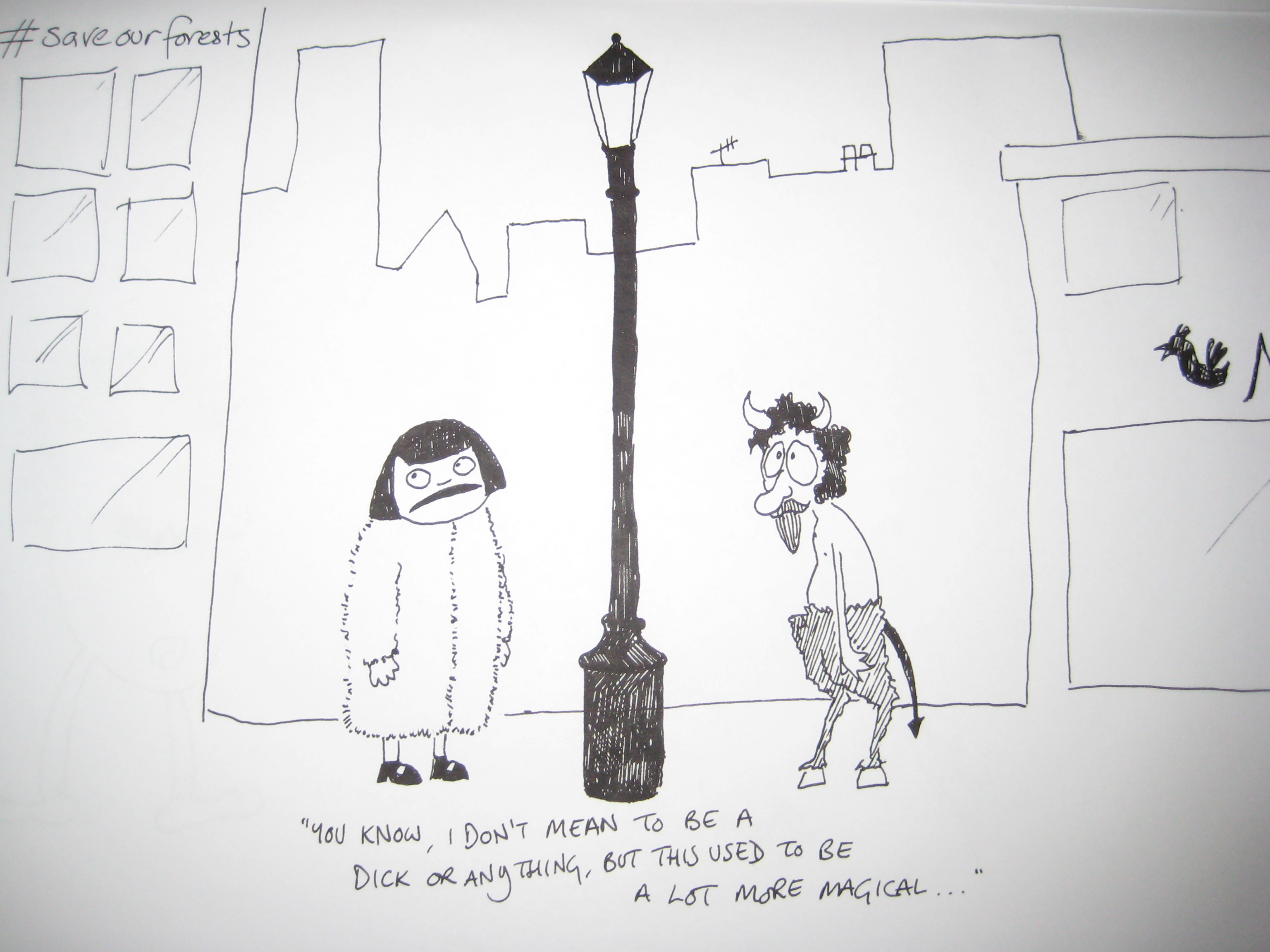
You know, I don't mean to be a dick or anything, but this used to be a lot more magical
An occasional series of cartoons inspired by things, and posted on Twitter.
Here’s a little something I wrote when I was alone and bitter and twisted, too. In 2004. Hope it helps…
There are three different St. Valentines…
Each and every one’s a fucking martyr.
So, as you mouth the platitudes your latest prop against self-sufficiency wants to hear mumbled across the pillow this morning, remember this:
1) Married people get more cancer. Nuns and eunuchs have the lowest rates of cervical and prostate cancer recorded (there are no recorded cases of prostate cancer in eunuchs). These people don’t tend to be married.
2) One of you will die first. And they’ll probably wait until you’re old and incapable to do it. The nurses might change your nappies, and wipe the mashed potato from your chin, but they’re not going to fellate you the way you really like. Constantly.
3) It’s a statistical improbablity that you’re soulmates. There are 7 billion people in the world. If we each get one soulmate, you’re probably not even on the right continent. Chances are, yours is Chinese.
4) You can name ten people more attractive than the one you’re spending today with. And if you can’t, I will. Unless you are David E. Kelley.
5) It’s not going to last. After all, none of the others have.
Happy Valentine’s Day, you lucky, lucky bastards…
Originally published at Pastichio Nuts on February 14, 2004. Everything changes but you…

Image via Wikipedia
Dear Nick,
Be brief(s).
You talk too much. Too many words drop out of your flapping head, and flounder about on the floor like dying carp. Word after word after word comes out, and it has to stop. Preferably by the Friday after next.
We all talk too much, of course, but it is one of the biggest problems when you’re starting in standup. Every word you use that isn’t a punchline means your audience is waiting longer for their punchline. Every word you use that isn’t setting a punchline up is just wasted.
Although there are many, many ways of doing standup comedy (and I am hardly one to talk about using too many words), to begin with you must master the setup and punchline. For your first set, we will be almost exclusively working on the basis of setup and punch. Any word that is neither setting your joke up (misleading the audience, heightening their expectations, putting them in a mood you are bout to undercut) or paying one off is an unfunny word. It’s a useless, wasted beat in your routine. It is, although it is filled with sound, dead air.
You, I think, may well have to conquer your natural, professional hatred of silence. Silence is your friend. You can use it to intimidate your enemies, sneak a look at the notes written on your hand, or to feign a swoon, and wait for someone to carry you off stage. In comedy extra words are confusing, a distraction from the real job of making your audience laugh.
So, your first job is to think of some jokes. Your next job is to take out every unnecessary syllable. Every one. Evy on. N.
Related Articles
- The Comic Relief Crash Course In Standup Comedy: Lesson #1 (nathanieltapley.com)
- The Comic Relief Crash Course In Standup Comedy: Lesson #2 (nathanieltapley.com)

Image via Wikipedia
It’s a sad fact that despite having written sketches, plays, online series, and actual half-hour sitcoms that were broadcast on the television and everything, the thing which has most excited my parents was getting credited on The News Quiz. There is no prouder moment for a middle-class parent than when their child is writing additional material for Sandi Toksvig. Providing them with grandchildren pales into insignificance when your name is read out in the 6:30 slot on Radio 4.
And when I say ‘my parents’, I mean ‘me’. It was great fun: a furious whirl of reading papers, trying to squash the news into something vaguely amusing, and saying “Can anyone think of anything that rhymes with Andrew Lansley?”
It was exhausting and pressurised, having to produce joke after joke about occasionally abstruse economic stories, but it was also exhilarating. It was a real thrill to sit in the BBC Radio Theatre and listen to the show be recorded, hearing the instant reactions of the audience to the jokes that made it into the script. And to get to be in a Green Room with Jeremy Hardy.
Topical comedy is difficult and draining because yesterday’s brilliant joke is, today, a reference nobody understands. The fact that it dates so quickly means that there’s a huge appetite for new material, which also tends to mean that there are opportunities for newer writers, some of which I’ll list here.
Topical comedy was my way into writing comedy, it allowed me to develop my skills, hone characters, learn a lot about how to craft a joke, and get paid (a little bit) whilst doing it. If you write a good topical joke or sketch there are lots of places you could try to sell it, and you’ve a better chance as a newcomer than in almost any other field.
Stage Shows – Both The Treason Show and News Revue have open submissions policies and pay for anything they use. They won’t pay a lot and it will take a while for the money to arrive, but if it is funny and you send it to them, they are very likely to use it. Then: congratulations, you’re a professional comedy writer!
The Treason Show also holds meetings for its writers where (if you are Brighton-based) the director will tell you what they are looking for. It is well-worth going along to one or the other show to see what sorts of things work and don’t work, if you can make it.
These two shows provide a great apprenticeship in topical comedy. The first sketch I was ever paid for I sold to News Revue, and if one of the two shows doesn’t like your sketch you can always send it to the other. If the worst comes to the worst you can do what I did and become a writer-performer, get cast in the shows, and then refuse to go on unless they use your work*. This is blackmail. It is also very effective if you do it once the audience are seated.
Youtube – If you’ve written a sketch or a topical song that isn’t suitable for the other shows, or that you want to perform yourself, Youtube is a great way of doing it. Nowadays, if there is a certain amount of interest in your video (I’ve found that about 1,000 views over a couple of days seems to be the trigger), Youtube invites you to join its affiliate programme. You can then stick an annoying advert over the top of your sketch in return for money. Again, the financial rewards are fairly minimal, but it is at least a way of making something from your writing. Here’s what a video looks like when it has been whored out:
However, if your video contains any profanity, then they will not approve you for the affiliate programme. Instead you will be hunted down by a pack of slavering obscenity-hounds and have your remains fed to the crows. As happened with this video, which I forgot I had sworn in the middle of.
Radio – Newsjack has open submissions, and you should be sending them stuff. A series is running right now. Go away. Write a good joke, work out which of their segments it could be useful for and send it in now. Better still, write lots of good jokes and send those in.
Recorded For Training Purposes also has an open submission policy (or has had in the past), so keep an eye open on Writers’ Room for when that opens to submissions. Submitting to these shows is an excellent way to get your work in front of the eyes of joke-hungry producers. Following Jason Arnopp would be a good way to learn more about RFTP.
Comedians – If you are good at writing jokes, topical or not, you may well find that there are comedians who are willing to buy them from you. Keep an eye on the forums on Chortle, or advertise yourself there.
Online – BBC Comedy Online currently produce topical sketches, although their turnaround times for submissions tend to mean that if your jokes are bleeding-edge in their topicality this might not be the way to go. However, you can always make it yourself, and then see if they want to buy it. Other sites have, unfortunately stopped commissioning, and, with the demise of Comedybox and Funny Or Die UK, you may be better off making things yourself and putting them on Youtube for a while.
TV – There aren’t really many ‘open opportunities’ here, as such, but there will be occasional sweeps for ‘new talent’, and I got my first proper TV work (not that my appearances in Smile as The Queen weren’t proper, but you know…) from doing topical jokes.
If writing gags for TV floats your boat, why not follow Aiden Spackman, who is something of a god at that sort of thing…
Twitter – Twitter is a great place to practise gag-writing. 140 characters is a little limiting, but it encourages brevity and can give you an instant barometer of how funny people found something with the ‘Your Tweets, Retweeted’ tab. Note: clicking this can also be a tremendously dispiriting experience.
So, whilst topical comedy is hugely ephemeral and can require an enormous amount of thought and concentration for something that won’t be funny in a week’s time, it is still an area in which new writers can get their work performed, and can even make a little money out of. It’s tough, brain-scrunching work, but there are real rewards in terms of credits for getting it right. And a crushing sense of defeat and humiliation for getting it wrong.
Go forth and satirise…
* There are slightly different opportunities for writer-performers, and I’ll do a separate post on those next week.

 Nathaniel Tapley