This is an occasional series, the Comedy Book Reviews, in which I’ll look at various books and tell you how useful I think they are to the budding comedy writer, or writer-performer.
Full Disclosure: A review copy of this book was sent to me by the publisher. I didn’t spend my own money on it. I’ll leave you to decide how corrupted I may have been by that.
I’m a big fan of the Teach Yourself series. Almost a decade ago it was Ray Frensham’s Teach Yourself Screenwriting that helped me put together my first scripts, and started me on the path to my current – for want of a better word – career. I also learned to ask for beer in Danish from one of them, something that proved almost invaluable on one long weekend in Copenhagen in 2003. I’ve even got an unbroached copy of Teach Yourself Pitman Shorthand somewhere, in readiness for the day when I am reduced to offering outdated skills to faceless corporations for a living.
Just to be clear right from the off: this book will not give you the secrets of writing great comedy. In fact, I doubt anyone knows the secret of great comedy. Those people who have managed to write great comedy have only done it for short periods of time. I don’t think that those great comedians who have produced less than great work simply forgot the lessons of this book; but that great comedy is a mercurial, ephemeral thing that sometimes eludes even the most talented comedy writers. After all, even Richard Curtis wrote Blackadder: Back and Forth.
However, what this book will give you is a good grounding in many different comic modes and styles. It covers all of the basics, and, if you are new to comedy writing, it should help you in all sorts of ways. It’s not an innovative work, but it is packed with good, solid advice.
In many ways, it’s a good British answer to Gene Perret’s The New Comedy Writing Step By Step, which works up from writing gags to sketches to sitcoms. The exercises are useful, all could really help you tune comic ideas, and are more interesting than the writing of 101 Tom Swifties (as Gene Perret suggests). Seriously. I did that exercise. I now have 101 jokes I can never use.
All of the writing advice is sound, and useful, but the book is a little broad. Someone who wants to write great standup does not need the same skills as someone who wants to write a great sitcom, or a great sketch. As a short, helpful introduction to all of these disciplines, packed with facts and exercises, this book is hugely successful. Unfortunately, there are books which deal with each of these things in greater detail.
I would advise any new comedy writer to have a look at this book. There’s a lot of writing wisdom, a lot of helpful information, and a good introduction to many forms of comedy writing in there.
It doesn’t deal with anything in much depth, however. If you’re looking for how to string A and B plots, and act beats through a sitcom script, this isn’t the book you’ll need. If you want information about writing sketches for the web (probably the fastest growing area in comedy), this isn’t the book you’ll need. If you’re looking for information about where you can put your standup or character piece on, this isn’t the book you’ll need. This is the book you’ll need when you’re surveying the comedy world, wanting to write something, anything, but aren’t sure where to start.
It’s a good book, great value for the amount of information it packs in. It might not give you the secrets of great comedy, but it could do something more important. It could give you the skills to get your first comedy, possibly terrible comedy, up on stages in front of people. The Secrets To Writing Terrible Comedy. Because that’s what you’ve got to do. And that, of course, is the first step towards writing great comedy…
Two years ago we released the first of the In The Gloaming podcasts, for Hallowe’en 2009. Our original plan was to make six. We got to four. (If you want a list of some of the many things we did wrong, I wrote a long post-mortem here. In fact, if you’re podcasting it is full of useful Dos and Donts. Mainly Donts.)
However, I got to work making half-hour horror comedies with some incredibly talented people. The casts included: Ruth Bratt, Michael Greco, Lizzie Roper, John Voce, John Hopkins, Zoe S Battley, Darren Strange, Sally Chattawa, Emma Powell, and Rachel Stubbings). I got to make one of those people wail “But these are my Beppe shoes!”
Anyway, because nothing is never truly dead on the Internet, and because it’s Hallowe’en, why not download one (or four), and have a creepy, funny Samhain? The Archive with all of the episodes is here. And then tell your friends.
In fact, don’t even bother to do that. Just click down there and start listening right now. Just click. DO what the creepy man says and click. What could possibly go wrong? After all, it’s Hallowe’en…
In The Gloaming may be a corpse, but it’s an animated one.
Sort of.
(Oh, I also have a short story in this month’s issue of Black Static, Britain’s foremost horror magazine, available at all good newsagents. End plug.)
I’ve never had anything against Paddy Ashdown. I’ve always thought of him as a sort of genial, auburn raisin in camouflage gear, crinkling with amusement (or outrage) on Question Time, and occasionally being wheeled out at conference time so that young Lib Dems can come and dip their fingers in his facial crags and dream of hung parliaments.
No, I never had anything against Lord Ashdown until he piped up in the Lords debate over the Owen / Hennessy amendment on the Health And Social Care Bill yesterday. The amendment argued that the bill was such a drastic alteration to the way in which the NHS functioned that parts of it should be examined closely by a special committee. At a crucial moment as the amendment was coming to a vote, Lord Ashdown sputtered into life:
“If it must be considered in a committee,” he railed, looking for all the world like a squared-off orangutan scrotum in an ill-fitting suit, “What on earth is our function?”
Well, quite.
What is the function of the House of Lords? Except as an affront to the very idea of democracy. It somehow manages to be the least-democratic of the Houses of Parliament, which is saying quite something. (For the record: No, I don’t think a minority of swing voters in marginal constituencies deciding the government of the country for everyone else twice a decade is what Aristotle was thinking of when he talked about democracy. Had he any idea how close to oligarchy and aristocracy it could look, he might not have been so set against the idea of government by the people.)
Really, would someone like to explain what the function of the House of Lords is?
It’s not even like it’s a bulwark of tradition, because those peers who do not have to worry about the shifting winds of political opinion, the hereditary peers, have mostly been ditched. What’s left are those who could suck up to a government enough to be made a life peer.
Yesterday’s vote was defeated by 68 votes. There have been 100 new Conservative peers created since the election. David Cameron, has appointed more peers more quickly than any other Prime Minister in history, so much so that the chamber gets too full to accommodate them all. And their colostomy bags.
The Coalition pledged to reform the House of Lords, presumably by stuffing it to bursting point with placemen and placewomen, so that it would reform in much the way that ‘reclaimed meat’ does. They will become one, immense, dense, Spam of a House, issuing edicts from above. Lordzilla, filling her egg chamber – sorry, debating chamber – almost entirely, feasting on Manuka honey and stoat-corpses. Sometimes, if you peer closely, you’ll see the face of Shirley Williams or Floella Benjamin stuck just underneath the surface, screaming silently.
The other view you hear is that their greater life experience allows peers to take a more balanced, nuanced look at legislation. Lord Hunt of Wirral, who introduced the Health and Social Care Bill into the Lords, is an exec director of Beachcroft, which advises many private health companies. Indeed, as reported in The Mirror, in a brochure advertising their lobbying services for private healthcare firms, Beachroft says “In David Hunt and Charles Clarke, Beachcroft has two former senior Cabinet ministers with unrivalled knowledge of the workings of Westminster.” In all, 40 peers have financial interests with private healthcare firms. Thank goodness their outside interests allow them to take a dispassionate look at legislation.
The other argument one hears is that the Lords serve as a corrective and a hindrance to The Commons. Unfortunately, it’s not true.
As we saw time and time again throughout Labour’s period in government, the Lords were more than happy to wave through the Terorrism Act of 2000, or the one that followed not a year later, the Identity Cards Act of 2006. No assault on our civil liberties was too egregious to rouse the Lords from the slumber.
Well almost none. The one time in living memory the Lords have actually behaved in the way the Lords are nominally meant to behave was over, wait for it, fox hunting! What is it that can actually generate enough fury in the Lords to get them to send a bill back repeatedly? The right to have one animal tear another apart! And not because they are outraged by it, but because they support it.
The Lords is a profoundly undemocratic institution. The only argument for their continued existence is that they actually, on occasion, act as such. If there is a role for the Lords, it must be to represent those interests which are not represented by the majority party in the House of Commons, or at least to ensure that their rights are not abridged. It must behave like the undemocratic institution it is, if it is to have a purpose at all.
Or is it really just to provide a comfortable retirement home for Olympians and the principals of Oxbridge colleges?
One of the arguments used by the government every time it tries to get rid of the right to jury trials (oh, that’s right, they did! With the Criminal Justice Act 2003! Did the Lords do anything about it? Um…) is that juries sometimes return ‘perverse verdicts’. The argument runs that because juries decide that , despite the law, someone should or should not be considered guilty of an offence, they should be phased out.
But that is the point of a jury.
If justice were best served by the constant and consistent application of the law as written, then there would be no need for juries. Juries are there to look beyond the law and at the individual details of a case. They are there as reasonable, normal members of the community to make a determination as to whatever is just, in spite of the law when necessary. Because the law is a blunt instrument, it doesn’t fit all cases equally well, and the best system we have is to get a group of people together to discuss the case at a human level and come to a decision. Perverse verdicts aren’t a weakness but a strength of jury trials.
And the same goes for the Lords. If they aren’t perverse, they are pointless. And as we have seen, they are unwilling to be perverse. They are an ‘upper’ chamber in thrall to those in the ‘lower’ who appointed them. They are a bizarre anachronism, an insult to all thinking people, and every day they form part of our government is another day away from us ever achieving anything like democracy.
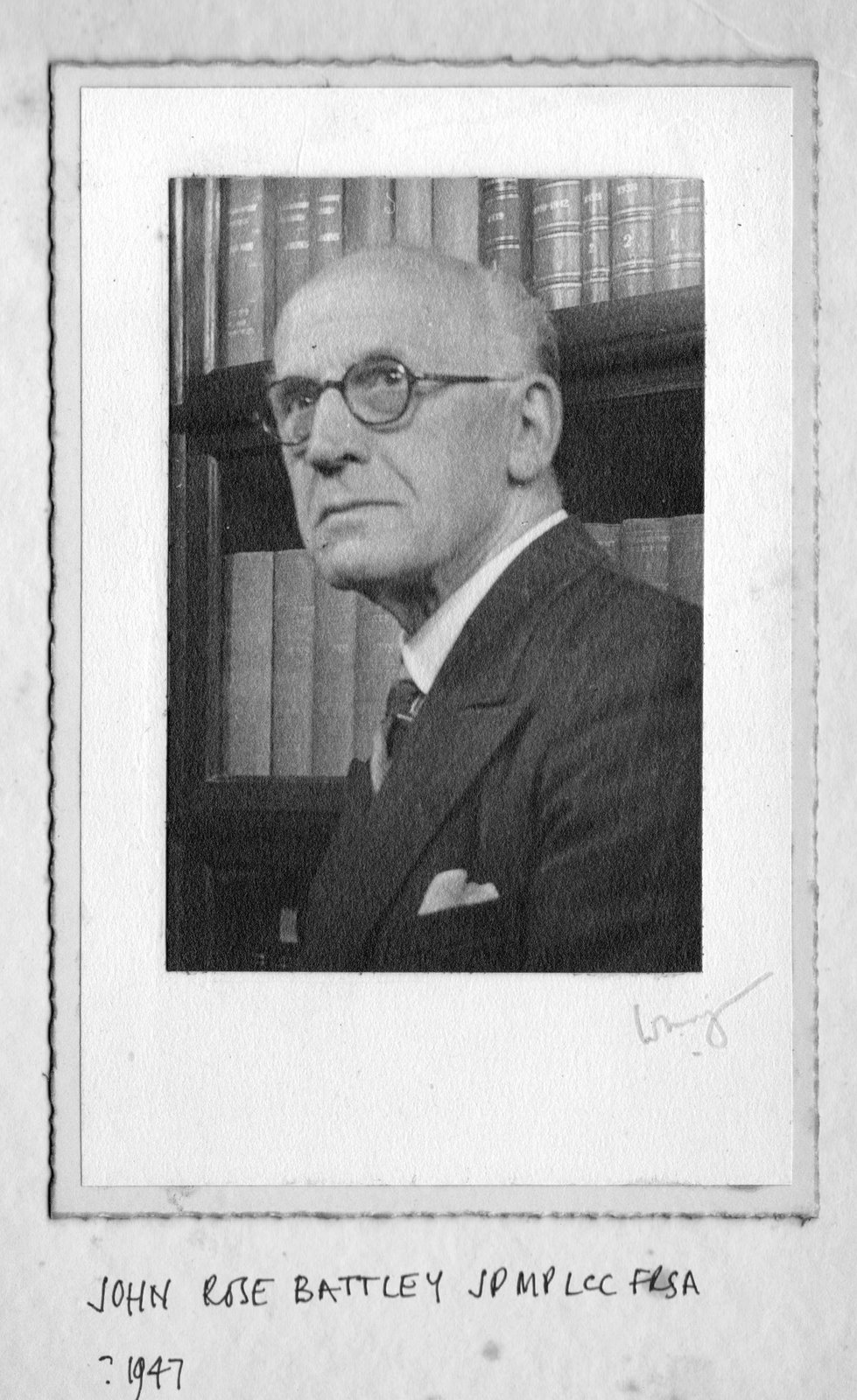
John Rose Battley was never a well man. As a conscientious objector in the First World War, he was sentenced to work in a market garden. On a cold day in February, whilst he was putting 2,000 cauliflowers under cloches, he noticed that his toes were turning black. Despite having never been to the trenches, John Battley was getting trench foot.
With his brother, he started his own printing firm in 1897, working out of a room above their father’s shop. He built the business up, it survived his brother leaving, its proprietor not being able to work at it during the First World War, the Great Depression and at least one extended nervous breakdown, which lasted many months in 1933. That printing firm, although its name has changed, is still around today.
Battley was in his 50s by the time he married in 1933, and that seemed to redouble his activity. He was already an active member of his church and local choir, a leading light of the Temperance Society and the Rotary Club, and in 1938 he was elected to the London County Council, as a Labour member for Clapham.
During the war he worked on the Housing Committee on the LCC, even as his own house was bombed in the V1 attacks. In 1945 he stood for parliament, and became the first ever Labour MP for Clapham. He wasn’t a vocal MP. Although he made notes, he never made a speech in the House of Commons, but he was an ardent worker on behalf of his constituents. He voted with the government most of the time, the only exception being the National Service Act. 30 years after his pacifism had forced him to give up his business, he still believed that no Christian should ever have to (or, indeed, could) perform military service, and so he rebelled against the government once, in 1947.
Whilst he was an MP he also stayed on as a member of the LCC, an active Rotarian, church member, choir member, and managing director of his own business. By 1950 the stresses had got the better of him, and he did not stand for re-election. Indeed, he had another breakdown shortly thereafter, and stayed in a hospital until he died in 1952.
Without knowing it, on 5th July 1948 this quiet, dedicated man saved the life of his grand-daughter and great grand-daughter, neither of whom he was ever to meet.
By voting for the National Health Act, John Battley made sure that when, almost 60 years later, 29 hours into labour, his great grand-daughter – my daughter – Eleanor decided to get into severe distress as she tried to enter the world sideways, her life was saved. Both she and Zoe, Zoe Battley, received the instant care of two paediatricians, two midwives, and at least three nurses (I lost count, I was busy worrying, and wondering if I could sneak out with the gas and air canister).
Over the 34 hours that labour took we had (I say we, Zoe selfishly used most of the drugs herself): heart monitors, midwives, gas and air, an epidural, a room to ourselves, three trips to the maternity ward (three painful trips home), a ventouse (don’t ask), synthetic hormones that accelerate contractions, pethedine for slowing contractions right down. And in between all of the worry about how much pain my wife was in, whether or not I’d packed any of the right things, whether I was going to be a good dad, or, as things got more serious, whether I was going to get to be one at all, the one thing I never had to worry about was how much the whole thing was going to cost. As a self-employed comedian of variable success, I didn’t have to worry whether or not I could afford the things and people that kept my wife an child alive.
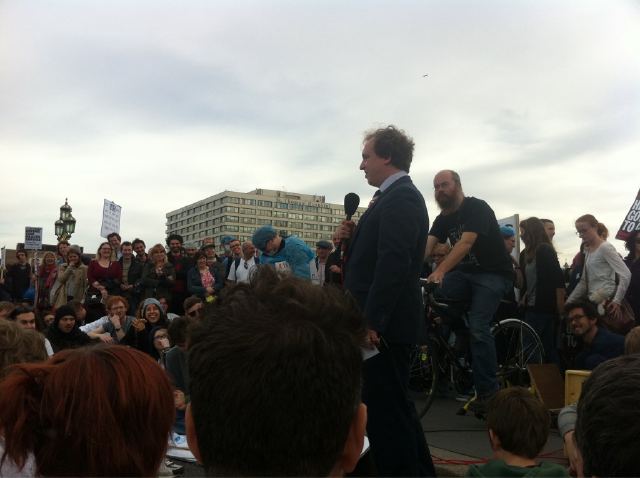
Behind me is the hospital in which my wife was born, picture by Tiernan Douieb
Some people, of course, will argue that this presents a moral hazard. If I am never aware of the costs of treatment, I won’t behave in a way that avoids unnecessary treatments; that health care free at the point of delivery encourages poor decision-making. What that means in this situation I’m not sure I understand. Perhaps I should have impregnated my wife with a more sensible-sperm, which would have seen the birth canal as an opportunity for emerging normally rather than doing somersaults. Perhaps I should have severed the nerves in Zoe’s spinal cord myself as the contractions started, because epidurals don’t grow on trees. Perhaps I should have had to choose which of the two, my wife or my daughter, we could actually afford to treat. Perhaps that would have taught me not to be so feckless. Doesn’t take more than a funeral or two before people start making better life choices, right?
62% of bankruptcies in the USA are down to health care bills. People lose their houses because they get ill. And they aren’t uninsured people. 78% of those people had insurance. Insurance that didn’t, actually, insure them in any meaningful way at all.
It will confuse some people, I know, that someone so vehemently anti-government, a left-libertarian, someone who some days – whisper it – is probably an anarchist should have gone onto a bridge to defend a monopolistic state health provider. Those people are confused as to what Andrew Lansley’s Health & Social Care Bill is. The choice isn’t between a state provider and a free market. The choice is between a state provider of health run for the general welfare of the people it serves, or a state monopoly provider of health that is run to best produce profits for private healthcare companies. It would be bizarre to bemoan politicians plundering the public purse, but to cheer when corporations do it.
I’m not saying Andrew Lansley is a shill for private healthcare companies. That’s his wife’s job. I’m not saying that the £21,000 he received from John Nash, chairman of Care UK and founder of Sovereign Capital which owns several private healthcare companies would have in any way influenced his opinions on the issue of whether private companies should be able to profit at the expense of the NHS. I’m not saying it. But he is. In a speech in 2005, he said: “Demanding uniformity will negate the benefits of competition. How can competition work, whether on prices or quality, if it does not lead to variation and divergent outcomes?” Or, in other words, different people will get different levels of treatment under the NHS, otherwise competition would not work. His vision is an ideological one in which ‘competition’, rather than the needs of patients, is paramount.
And this isn’t a move towards a free market, or towards real competition. It is simply a move that allows private companies to cherry-pick profitable services. Services that are already provided. There is no guarantee that they will provide them better (the responsibility for the Health Service is to be turned over to a quango who are not answerable to Parliament, so out politicans can’t be to blame for however bad it gets in the future), the only guarantee is that money that once would have flowed through the NHS will now flow to shareholders in private health companies. Because ‘competition’ is the aim, not patient welfare.
This is pure kleptocracy. Assets that have been built with the public purse, maintained at the taxpayers’ expense, are to be auctioned off. And what’s worse, private health care companies aren’t even going to have to act like, you know, businesses to get in on the act. They won’t be competing in any meaningful sense, under the umbrella of the NHS, they will simply be pocketing our cash without having to guarantee standards in the way the NHS currently does.
The fact that the local health authority sees no conflict of interest for the practice in Yorkshire that recently started charging for minor skin surgeries highlights the bizarre situations that we must nod through in the name of ‘competition’. The fact that the same GPs at the same surgery will be in charge of deciding if funds are spent on a procedure, and in charge of performing the same procedure privately if they decide it isn’t is outrageous. That’s a moral hazard. You can tell, because it contains a moral element. Eating too many chips is not.
And don’t let them tell you these are cuts. That we need to make these cuts. This plan makes the NHS more expensive. It will cost £1.2 billion more to implement these changes than to not do it, and there are no cost savings at the other end. So we will end up with a service closer to France’s or America’s in that it will cost much more than the one we have at the moment.
And what is so clearly, arse-breakingly frustrating about the whole thing is that it received any Lib Dem support at all in the House of Commons. It’s like they don’t remember the clause in the Coalition Agreement, the line in the sand which, if crossed, would lead to the dissolution of the Coalition, the one about “no more top down reorganisations of the NHS”. Of course, by the time the policy documents for the Coalition emerged a couple of weeks later it was hedged with many qualifiers. The Lib Dems cannot have any serious claim to be a restraining influence on the Tories if they roll over at the disembowelling of one of the nation’s most loved institutions.
And fuck the Labour Party, too. A supine, spineless, useless thin drizzle of urine that leaks down your face and calls itself champagne. Without the NHS reforms of 2000 and 2008, this Bill would have been impossible. As it is, it is only an extension of the ‘competition’ ethos introduced into the NHS by none other than Tony Blair. You remember, it was when he was telling us that anyone who objected was a ‘force of conservatism’ and that he had ‘no reverse gear’. Vehicles without reverse gears are terrible vehicles, Tony. Most people buy ones which have reverse gears. (Oh, and equally, George Osborne, Plan Bs are a good thing. Doing contingency planning is just sensible, yes? God, I hate them all…)
The ground was prepared for all of this by the Labour Party. They put the ideological argument for it years ago. Some might rail against this now, but what are they doing about it? Sally Bercow accidentally ended up at #blockthebridge because she was having a walk with her children. I saw John McDonnell there, but no other Labour MPs. They are a disgrace, and I’d suggest that they hang their tiny heads in shame, although it’s quite clear they have none.
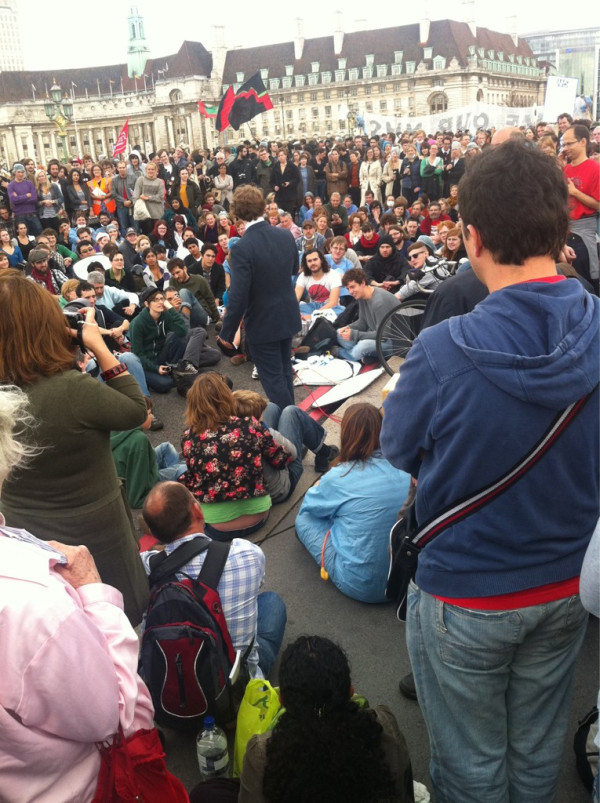
Me, in front of the LCC building, picture by Sunny Handal
And so I was proud to stand on that bridge. Proud to stand between what used to be the LCC building, and the Houses of Parliament. Proud to stand with a couple of thousand people in front of St Thomas Hospital, where Zoe was born. Proud to speak to, and on behalf of people who believed in a better future.
So, it’s too late to lobby your MP now. It’s too late to have come down on Sunday (you missed Josie Long, Mark Thomas, Nick Revell, Chris Coltrane, Tiernan Douieb, Grace Petrie, Lisa Egan and Nadia Kamil. You are a fool.) It’s too late to adopt a peer, although you could try faxing them something this morning. In a few hours we will know one way or another, whether or not John Battley’s printing business will outlast the greatest achievement of the 1945 Labour government.
The one thing you could do, right now, stop reading and do it, is to sign this petition. 115,000 people did it yesterday, but it’s not enough. Sign it, send it to your friends, tweet about it, talk about it on Facebook, argue with Tories about it (not that I’ve met a single real-life Tory who thinks it’s a good idea). For these last few hours, write and jump up and down and do whatever you can to make a noise about this. The only thing that might sway the crossbench lords (and don’t think I don’t find it utterly galling to have to go grovelling to someone who earned their place in the legislature by popping out of the right mimsy) is if they are left in no doubt that hundreds of thousands, millions of people are angry, worried, dismayed by this.
John Rose Battley was never a well man, but he left behind him something to take care of us all. Let’s do our bit to take care of it for the next couple of hours.
Yesterday, Sir Ian Bowler went to see the rabble on Westminster Bridge who were attempting to ‘save the NHS’. He likes to think he changed a few minds. And sexualities.
And some anger splurged onto Twitter. Fortunately for you, it’s all been collected up below. It’s a moment by moment account of the development of my loathing for Nick Clegg. Enjoy.
We all know that the Queen poos (unlike Prince Philip, who vents clouds of highly-acidic faecal gas from a fleshy nozzle just beneath his chin, before blinking his inner eyelids and retreating to the warmth of the Royal Egg Chamber), but few of us have really considered the implications of this.
There must be days when Her Majesty, Monarch of the United Kingdom of Great Britain and her Islands clenches her little fists, grabs hold of the seat and really bears down to dislodge a particularly awkward chunk of digested swan. (This is in stark contrast to Barack Obama, whose turds slip out of him like otters returning to the wild.) At times like these, as her tiny heels drum against the floor, a fine sweat breaks out on her aged forehead, and she prays to a higher power (higher pooer?) to just get the damned thing out, she must hope that if this is it, if she dies here, that they take her corpse and arrange it so it looks like she was doing something less embarrassing when the time came. Something like feeding her corgis, opening a hospital, or cutting the brake lines on a Mercedes-Benz W140.
There are probably worse ways to go than carking it in the middle of a poo, but I’m struggling to think of any now. Here are nine more who expired in the water closets. Flush-in-the-pans.
9. Elvis Presley – Although one of the most famous to die in their bathrooms, Elvis wasn’t found on his toilet. He was several feet away from the toilet, where he had apparently crawled in an attempt to get help, interrupted whilst using the toilet. He was obese, and suffered from glaucoma, high blood pressure, liver damage, had a history of abusing prescription drugs, and an enlarged colon. One of his coroners said he had ‘the arteries of an eighty-year old‘. Although there is some dispute over whether it was the massive drug intake, the weight, or the actual ‘straining at stool’ (as his biographer puts it) that caused his heart attack, the moral remains the same: you can’t have too much fibre in your diets, kids.
8. Evelyn Waugh – the ‘bright young thing’ of the 1920s, and later Catholic propagandist came home from church one Sunday, went to the loo, and never came out again. He ascended to the Heavenly Throne whilst mounted on his.
7. Catherine the Great – Catherine the Great is perhaps the only person in history about whom it can be said the best version of the story of their death is the one where they die, grunting on the toilet. Because in the other popular version of the Catherine the Great’s death she was crushed to death by a horse during the act of coitus.
6. Uesugi Kenshin – Kenshin was one of the most powerful Japanese warlords of the sixteenth century with a prodigious capacity for booze. Although most people agree that he died on the toilet, there’s a lot of dispute over whether it was his prodigious drinking, or a cesspit-dwelling ninja that finally got him. I like to imagine a combination of the two. A booze-addled bum-ninja.
5. Christopher Shale – Not hugely famous in and of himself, Shale is notable for two things: being David Cameron’s constituency aide, and dying in a toilet at the Glastonbury Festival. In one move he managed to replace the popular image of Tories as being tangerine-chomping auto-erotic asphyxiators, start rumours about shadowy conspiracies and leaked documents, and get everyone to agree that people over 50 should not attend music festivals.
4. Edmund Ironsides – Stabbed in the anus by a Viking hiding in his toilet. There is literally nothing about that last sentence I don’t like.
3. Don Simpson – A heart attack waiting to happen, Top Gun Producer, S&M enthusiast and allegedly prodigious drug user Don Simpson died on the toilet, whilst reading a biography of Oliver Stone. Death must have come as a blessed relief.
2. King George II – Fat, palsied German George II was blind in one eye and hard of hearing by 1760, when he had a cup of hot chocolate and went to the loo. A few moments later a crash was heard, and the king was pronounced dead from ‘overexertions on the privy’.
1. Lenny Bruce – Lenny Bruce didn’t just die on a toilet, he died doing heroin on a toilet. Imagine being so in love with heroin that you don’t even want to finish taking a dump before getting high. “You know, I could wait, like, three minutes and then do this on the sofa. Nah, what’s the worst that can- urk!”
So, what has this litany of poo-related perishing taught us? What have we learned from these salutary tales? One thing. Toilets can kill you.
It’s been a bizarre few days. On Question Time we saw a nation agonising over the materialistic, greedy, celebrity-obsessed culture of its youth turn to Brian Paddick for answers. That’s I’m A Celebrity Get Me Out Of Here and Celebrity Come Dine With Me contestant Brian Paddick.
Lots of commentators have weighed in on the mixed messages the police have been getting since the deaths of Ian Tomlinson and Jean Charles de Menezes. Because, you know, it’s simply unrealistic to expect police not to beat innocent people until their hearts give out or shoot them in the head and at the same time still expect them to actually intervene to stop people visibly stealing things from shops. Until someone finds a way of distinguishing people who are committing a crime from people who aren’t committing a crime we should just let the police beat everyone, just to be on the safe side.
And last night, on Newsnight, an eminent historian approvingly (but in a qualified fashion) cited Enoch Powell‘s “Rivers of Blood” speech, and said that the problem with the country was “whites acting like blacks”. You can see the whole incident here, it takes ten minutes but it’s well worth seeing in context: http://www.bbc.co.uk/news/uk-14513517?utm_source=BBC+News+UK&utm_medium=twitter
What’s most shocking about the whole thing isn’t his constant conflation of ‘black’ with ‘black culture’ with ‘a particular sort of violent, destructive, nihilistic, gangster culture’. It’s not the part where he asserts that if you closed your eyes you would think David Lammy was white. It’s not even his bizarre reading of a text message, righteous contempt dripping off every emoticon he attempts to pronounce.
No, what’s most shocking is that the quality of our history teaching has become so debased, and the basic standard of our historical knowledge is so poor that Starkey can arrive unprepared and behave like a lazy undergraduate trying to derail a tutorial because they haven’t done their homework.
I say that as someone who was once an exceedingly lazy undergraduate who almost never did their homework.
It works like this.
1) You arrive at the tutorial having only read one thing from the reading list and having picked one incident from what you read.
2) You then say the most shocking and counterintuitive thing you can about your incident at the beginning of the tutorial and then, like a mastiff with a hare, or Niall Ferguson with a toddler, you grip and shake and worry at that one thing you know until you have drained it of all interest and meaning.
3) The incident you choose should be sufficiently obscure that if you pontificate about it loudly enough people will assume you know more about it than they do.
4) In order to spin this out for a whole tutorial you must at least know one picturesque fact, which you can describe and analyse in detail (in Starkey’s case the teenager’s text, or the woman putting on shoes outside the shop) and have one quotation you can give at length and in full (like Starkey’s paraphrase of Enoch Powell).
5) Every time anyone tries to widen the discussion, you must bring it back to the few pungent facts you have at your disposal.
6) That’s it.
For instance, I once got through a whole tutorial about Richard II knowing little more than the fact that Thomas of Woodstock, his uncle, had burst into the child king’s bedroom during the Appellants’ Crisis.
Every time anything was mentioned, I would bring it back to the impact having an uncle burst into your bedroom threatening violence must have on a child. I blamed everything that happened from 1377 – 1395 (when I had stopped reading) on that one incident, even though most of them happened before it.
I left without learning anything more about Richard II, but having successfully concealed my ignorance for another week. I didn’t even know Richard was deposed until I was doing my one bit of reading for the Henry IV tutorial the next week.
And that tactic was followed almost to the letter by David Starkey last night. I’m not saying he’s lazy. He might be incredibly hard working but rather dim.
He starts by grabbing our attention with Enoch Powell, a bogey man we all know about but few of us have read. We are soothed into listening by delightful phrases like ‘lambent flames’. And then he delights us by implying that Powell was wrong: the violence that was coming was not between races but between…
And this is where he falters. He is not as nimble as he thinks he is. The obvious way out of his bind would be to revert to a class analysis, but this is anathema to an old Tory like him. So he stretches: it’s not a clash of races, it’s not a clash of classes, it’s a clash of cultures.
And suddenly he’s no longer on thin ice, he’s not even on ice at all. His legs whirl beneath him, desperately trying to execute the intellectual pirouette he envisions, but he is simply splashing at the murky water below him. There is nothing for him to get traction on because he hasn’t thought very deeply about cultures at all, so he’s left pedalling the in air like an aquatic Wile E. Coyote, desperately churning the mixed metaphor below him.
For while there is very much a sense in which a “violent, destructive, nihilistic gangster culture” is involved with our social problems, he will not, cannot accept that that is a culture that is widespread. His allegiances won’t let him see this ‘shopping with violence’ as a radical outcropping of Thatcherism. He’s trying to skip through fields of thought-experiments, but he is hobbled by his own adherence to ideology.
So he shorthands “violent gang culture” to “rap culture” to “black culture” to “black” and uses them interchangeably. He has the kernel of an interesting, nuanced analysis, and about new cross-racial youth cultures but it is crippled by his inability to put it into words. He’s so eager to shock with how transgressive his thoughts are that he fails to give them any, you know, thought.
In Salford, most of the rioters I saw were white. The one they interviewed on the news said he was rioting to protest against the Polish taking jobs. Starkey’s argument runs. This was a special kind of riot, a ‘shopping with violence’, concentrated on looting. White people don’t loot. White people did loot. What was the factor that made white people loot? Black culture. Or, to qualify it as he does a couple of times: ‘black male culture’. The circularity of the argument and its implicit assumptions are clear.
It’s so self-contradictory that the high priest of personal responsibility ends up blaming a whole race for the people of another race who burned down buildings.
White people don’t loot. How do we know this? We must take it on faith because David Starkey, eminent historian, states it to be true. Does he give evidence? No.
In Starkey’s world, those who trashed the Savoy Palace during the Peasants’ Revolt all did so because they were outraged about the legal status of serfs, were angered by wage laws that failed to reflect the new reality of the scarcity of labour since the Black Death, and a growing anti-clericalism that would result in Lollardy. Not the chance to get their hands on some of John of Gaunt’s golden candlesticks.
Except, of course, we’ve got evidence that that wasn’t the case at all. The leaders of the riot were very careful to tell no one to loot, they didn’t want to be seen as thieves, and they ground up the jewels and plate they found before throwing them into the river.
Except they had to throw a man in as well, who was found to be hiding bits of silver plate to hang onto for himself.
Or the cellar full of people who were helping themselves to the Duke of Lancaster’s wine when the roof fell in on them, killing them all.
I wonder if Starkey would have been more astounded or less at the sight of them guzzling away on stolen wine than he was by the woman who tried on a pair of trainers. They weren’t even bothering to flee the scene, so sure were they that there would be no repercussions.
Perhaps the moment when he gets himself into most trouble in his attempts to rule out a class analysis for his cultural one, is when he finds himself saying “If you were listening to him [David Lammy] on radio, you would think he was white.”
Bound up in this is clearly the assumption that to speak respectably, is to speak ‘white’. It’s indefensible, even Toby Young’s defence throws its hands up in the air at that point, just saying “He didn’t mean it like that.” Like there is another way to mean it.
(Oh, and yes Toby, Starkey was doing little more than parrotting the received wisdom, he also showed the racist conceptual underpinnings of the received wisdom.)
Accent is clearly an identifying feature, but what it identifies, usually, is class. Not race. Accent is stratified by schooling, employment, the people with whom you spend your time. Even those assumptions will lead to shake and frequently wrong conclusions.
And why would you even turn the screen of your television off anyway? Should we be outraged that the purveyors of radio are all depriving us of the information we need to make important snap judgements about people?
The real tragedy is not that David Starkey is ill-informed about certain subcultures and has a tendency to make generalisations based on race, but that he is allowed on television at all. His ill-informed, unprepared contrarianism is both misleading and tiresome.
I enjoy his waspish uncle persona, but it is a travesty that our one remaining television historian – the one who hasn’t decamped to the US – is more Teddy Taylor than AJP Taylor, more anal than Annales, more Ben Elton than G.R. Elton.
It is a tragedy that our national debate is so debased that starkey enjoys his position as sharp-tongued speaker of uncomfortable truths, rather than serial misinformer and thumping bore. starkey is the lowest-common-denominator Satruday-evening telly answer to history.
David Starkey is symptom of the dumbing down of our intellectual life. He’s X Factor for the Montrachet-drinking classes. He’s a twit.
(And don’t even get me started on Dan Snow. Anyone who can present a piece on The One Show and then have their other guest know more about it than him* is not an historian, no matter how many looters they sit on.)
*Al Murray destroyed Dan Snow after a piece he did about King John. Snow knew enough to fill his three minutes of Outside Broadcast time, but nothing more. It was pitiful to watch, and I hope that one day someone puts it on iPlayer.






 Nathaniel Tapley